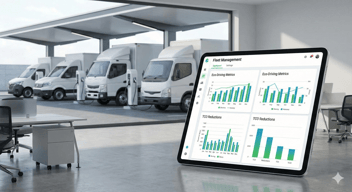
Key Takeaways: Mastering Your Fleet Budget
Effectively controlling your fleet budget requires moving beyond basic vehicle acquisition prices and adopting a highly strategic, data-driven approach to corporate mobility.
- Total Cost of Ownership (TCO) is the only accurate metric of your spending, capturing hidden long-term expenses like operational downtime, routine maintenance, and asset depreciation.
- Deploying smart telematics software instantly cuts fuel waste, lowers insurance premiums, and prevents major mechanical failures through proactive monitoring and driver management.
- Accelerating your electric vehicle (EV) transition protects your bottom line from volatile fossil fuel markets, rising carbon penalties, and high Benefit-in-Kind (BIK) taxes.
- Conducting a comprehensive operational audit and embracing flexible full-service leasing models are vital steps to safeguard and future-proof your enterprise finances.
Read the full guide below to explore these strategies in detail and learn how to transform your daily mobility costs into measurable business ROI.
What is the true Total Cost of Ownership (TCO) in fleet management?
The true Total Cost of Ownership (TCO) represents the complete lifecycle cost of a vehicle, extending far beyond its initial purchase price. It encompasses direct expenses like financing, fuel, and insurance, as well as hidden operational costs such as maintenance, downtime, administrative management, and end-of-life depreciation.
To effectively optimize your expenses, you must move away from evaluating vehicles based solely on their acquisition cost. Instead, TCO analysis gives you a holistic view of where your money is actually going. Typically, the acquisition or leasing cost only accounts for about 40% to 45% of the total expenditure. The rest is consumed by running costs.
Understanding your TCO allows you to make data-driven decisions. Here is a breakdown of the primary TCO components you need to track:
- Depreciation and Financing: The largest single cost factor. Choosing vehicles with strong residual values is critical for long-term savings.
- Fuel and Energy: Whether it is diesel, petrol, or electricity, energy consumption generally accounts for 20% to 25% of your costs.
- Maintenance and Repair (M&R): Preventative maintenance reduces the risk of catastrophic breakdowns and extends the lifecycle of your assets.
- Taxes and Insurance: This includes corporate vehicle taxes, registration fees, and premium insurance costs, which fluctuate based on your safety record.
- Hidden Costs (Downtime): When a vehicle is off the road, you lose productivity. Administrative time spent managing tolls, fines, and compliance also drains resources.
TCO Breakdown Comparison Table:
| Cost Category | Internal Combustion Engine (ICE) | Electric Vehicle (EV) | Optimization Strategy |
| Acquisition/Depreciation | Moderate | High (but improving) | Leverage corporate leasing to fix monthly costs. |
| Fuel / Energy Costs | High (subject to market volatility) | Low (stable, cheaper per mile) | Install smart workplace charging infrastructure. |
| Maintenance & Repairs | Moderate to High (more moving parts) | Low (fewer mechanical components) | Utilize predictive maintenance software. |
| Taxes & Tolls | High (carbon emission penalties) | Low (tax incentives, BIK benefits) | Capitalize on government greening subsidies. |
How can telematics reduce hidden fleet expenses?
Telematics software reduces hidden fleet expenses by capturing real-time vehicle data to improve driver behavior, optimize routing, and enforce preventative maintenance. By utilizing these insights, fleet managers can cut fuel consumption, lower insurance premiums, and virtually eliminate costly vehicle downtime, significantly boosting overall ROI.
[IMAGE: Detailed, B2B industry-oriented description, a glowing digital dashboard displaying fleet telematics data, maps, fuel efficiency metrics, and vehicle health alerts, modern, high-tech corporate aesthetic, dark mode interface.]
Investing in a robust telematics solution is no longer a luxury; it is an absolute necessity for cost control. We consistently see that businesses leveraging connected vehicle data achieve rapid returns on their investment. Here is how telematics directly impacts your financial bottom line:
- Fuel Management and Route Optimization: GPS tracking and intelligent routing software ensure your drivers take the most efficient paths, avoiding traffic and reducing mileage. Furthermore, telematics flags wasteful behaviors like excessive engine idling, which can consume significant amounts of fuel annually.
- Driver Behavior and Safety: Harsh braking, rapid acceleration, and speeding not only increase wear and tear on tires and brake pads but also lead to accidents. By monitoring these metrics and implementing driver coaching programs, you can drastically reduce your accident rate. This proactive approach often allows you to negotiate lower insurance premiums.
- Predictive Maintenance: Instead of waiting for a vehicle to break down, telematics systems send automated alerts for engine diagnostics and routine servicing. Addressing a minor issue before it becomes a major mechanical failure saves thousands in repair costs and prevents expensive operational downtime.
Why is the transition to electric vehicles (EVs) critical for budgeting?
Transitioning to electric vehicles (EVs) is critical for budgeting because it drastically lowers lifecycle energy and maintenance costs while shielding your company from rising carbon taxes. Furthermore, EV adoption allows businesses to capitalize on lucrative government grants, tax reliefs, and highly favorable Benefit-in-Kind (BIK) rates.
Fleet greening is actively reshaping the corporate mobility landscape. While the upfront sticker price of an EV might seem intimidating, the long-term TCO heavily favors electrification. As a fleet manager, aligning your strategy with environmental regulations (such as the LOM Law in France or evolving EU emission standards) is vital to avoid future penalties.
- Taxation and BIK Advantages: Governments are heavily penalizing high-emission vehicles while rewarding sustainable choices. Providing EVs as company cars significantly reduces the Benefit-in-Kind (BIK) tax burden for your employees, making it a highly attractive retention tool. Simultaneously, your company benefits from reduced corporate vehicle taxes and accelerated capital allowances.
- Energy Cost Stability: Electricity prices, especially when managed via smart charging at the depot during off-peak hours, are generally more stable and cost-effective than volatile fossil fuel markets.
- Corporate Social Responsibility (CSR): Beyond the spreadsheet, a green fleet enhances your brand's reputation. Clients and partners increasingly prefer doing business with companies that demonstrate a verifiable commitment to ESG (Environmental, Social, and Governance) criteria.
How to prepare your operational budget for 2025 and beyond?
To prepare an accurate operational budget for the future, you must conduct a comprehensive audit of your current TCO, forecast regulatory tax shifts, and implement a flexible mobility policy. Integrating scalable leasing options and budgeting for charging infrastructure early ensures long-term financial stability and agility.
Budgeting requires a proactive mindset. If you merely look at last year's spend to predict next year's costs, you will fall victim to inflation, regulatory changes, and unforeseen market shifts. We recommend following a strict compliance and optimization checklist to safeguard your finances:
- Conduct a Fleet Utilization Audit: Identify underutilized vehicles. If a van or car is sitting idle in the parking lot, it is bleeding money. Consider pooling resources or introducing corporate car-sharing for low-mileage needs.
- Review Leasing Contracts: Reassess your funding methods. Full-service leasing often provides better cost predictability by bundling maintenance, insurance, and breakdown cover into one fixed monthly invoice.
- Plan for Infrastructure CAPEX: If you are integrating EVs, you must allocate funds for the installation of charging stations at your offices and potentially at your employees' homes.
- Implement a Strict Mobility Policy: Clearly define what vehicles employees are entitled to, strict rules on private vs. professional use, and the consequences of traffic violations or negligent damage. Clear boundaries prevent administrative cost leaks.
Securing Your Financial Future
Thriving in today's corporate mobility landscape requires a data-driven, strategic mindset. When you fully grasp your Total Cost of Ownership, leverage advanced telematics, and actively pivot towards an electric fleet, you turn a conventional expense into a distinct competitive edge.
We stand ready to guide you through these intricate operational hurdles. Stop allowing hidden inefficiencies to deplete your capital or obsolete policies to stall your business momentum. Reach out today, explore our customized strategies, and unlock the exact tools required to master your fleet budget.
Frequently Asked Questions (FAQ)
What is the easiest way to reduce fleet costs immediately?
The most immediate cost reduction comes from implementing telematics to monitor driver behavior and optimize routing. By reducing engine idling, speeding, and unauthorized vehicle use, companies can often cut their monthly fuel expenditure by 10% to 15% almost instantly.
How does Benefit-in-Kind (BIK) impact my vehicle choices?
BIK is a tax levied on employees who receive a company car for private use. The rate is heavily tied to the vehicle's CO2 emissions. Choosing electric or plug-in hybrid vehicles dramatically lowers the BIK rate, providing substantial tax savings for the employee and reducing the employer’s related PRSI/social insurance contributions.
Is it better to buy or lease company vehicles?
For most modern B2B operations, full-service leasing is preferred. Leasing preserves your company's capital, shifts the risk of depreciation to the leasing provider, and offers predictable, fixed monthly costs that make financial forecasting and budgeting significantly easier.
How much does vehicle downtime really cost?
Downtime costs go far beyond the repair bill. You must factor in the cost of a rental replacement, the idle time of the driver who cannot work, and potentially lost client revenue or missed SLAs. Predictive maintenance is essential to minimize these severe hidden financial impacts.